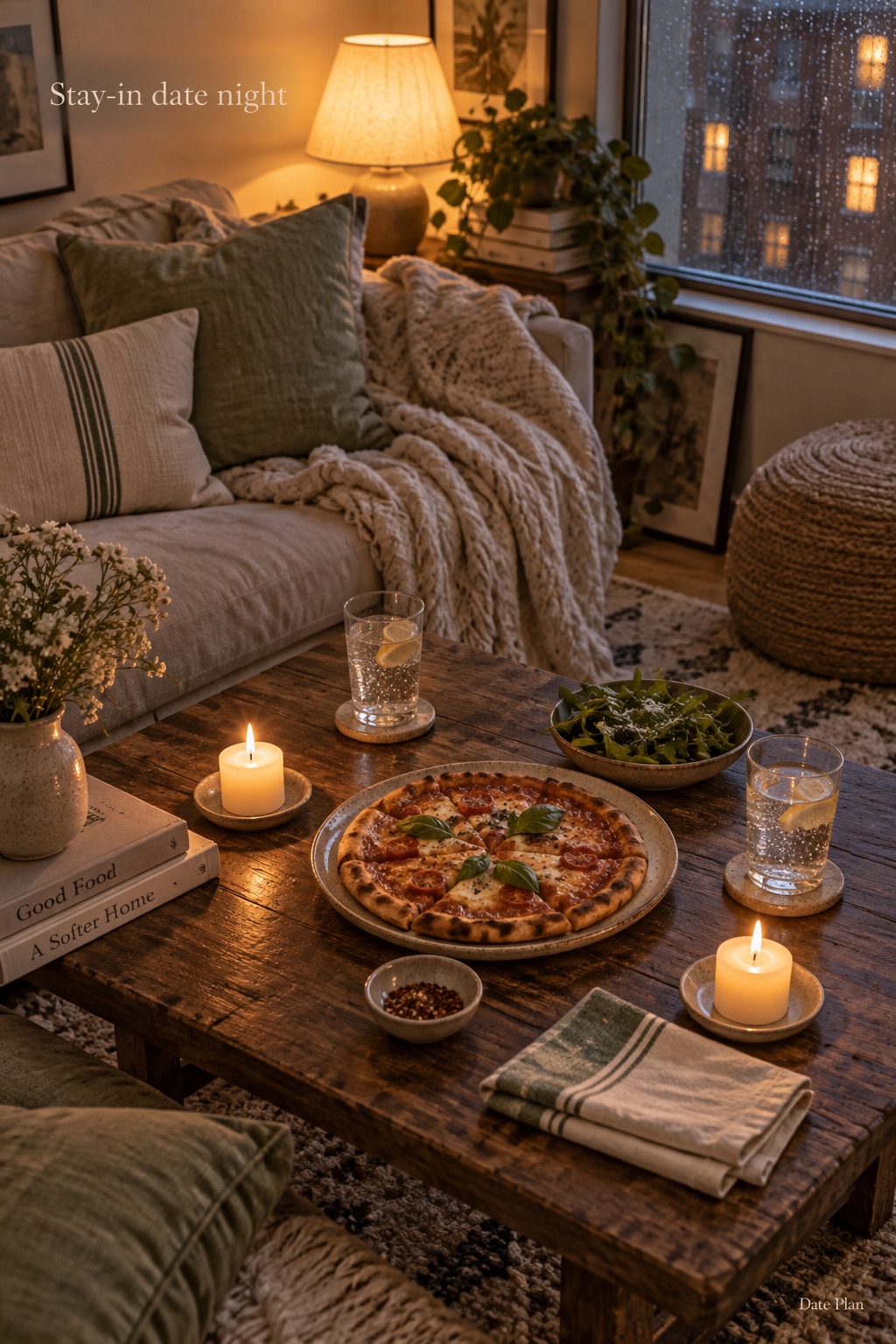
A tight budget changes the plan, not the standard. The nights people remember are rarely the expensive ones — but they are almost always the deliberate ones, and deliberate is the part that costs time instead of money.
Short answer: decide the number first, then spend it in one place — a single paid anchor the whole night is built around — and plan the free hours as carefully as the paid ones. Cheap nights go wrong when they imitate an expensive night at a smaller size. They work when the good part is one specific thing you chose, and everything around it is free, timed and easy to leave.
Reallocation, not deletion
Most date budgets are spent the same way: a chunk for dinner, less on drinks, some on getting there, a little on whatever comes after. When money gets tight, the instinct is to reduce every line by the same amount. That is the mistake, and it is why so many cheap nights feel like a concession.
A scaled-down version of a full-price night keeps the shape of the expensive evening and removes what made it worth doing. Half of a good dinner is not half as good — it is a meal with a smaller portion of the reason you went. What money buys on a date is not food or a table; it is the sense that the evening was built for the two of you, and that sense lives in specific choices, not in the total.
So cut the middle rather than the peak. One paid thing done properly beats three paid things done at half size. If you have never added up a whole evening, it is worth ten minutes before deciding what to drop: where the money actually goes is usually not where people guess.
One paid anchor, everything else free
Every good cheap night has the same spine: one paid anchor, and everything else free by design. The anchor is the single thing you pay for and build around — a table, two tickets, a class, the dessert you go out for. Its job is to be the part that is hard to improvise and hard to do at home.
Choose it by asking which one item is the reason this is a night out rather than another ordinary evening. If nothing passes that test, you do not have an anchor — you have a list of small purchases, and a list is the most expensive shape a cheap night can take.
Two rules keep it useful. Keep it short: sixty to ninety minutes of paid time is plenty when the free parts on either side are planned, and a long anchor leaves nothing to be free with. And book it first, then build outward, so everything else exists to get you there relaxed and on time. An anchor you had to chase is not an anchor, it is pressure.
Three nights, three budgets
These are planning shapes at three spend levels, not quotes, averages, or claims about what anything costs where you live. The amounts only make the structural difference visible.
Budget
The paid anchor
What stays free
Watch out for
Nothing at all
One dish or project that needs forethought rather than money — a long cook, something you make together, a film you both chose in advance
A walk with a destination, the phone-down stretch, the evening after
Drifting: with no booking holding the shape, you set the start and the end yourself
A small amount
One small paid thing — two drinks somewhere you like, a gallery ticket, the dessert you go out for
Everything before and after it
Spending it all on the middle, with nothing left for the walk after
A real but modest amount
One booking with a start time — a modest table, two seats at something
Transport, the first stop, the after, all of it
Upgrading the anchor until the rest of the evening is unaffordable
Notice what is missing: the number of stops. One anchor and two free parts beats the same money spread across four small disappointments. The date night budget calculator costs a whole evening out in about a minute.
Planning the free parts
The free parts are not filler. They are most of the night, and they need the same three things a paid plan needs: a start time, a place, and an end.
Give a walk a destination, even a small one — a viewpoint, the far side of a market, the street with the good bakery. "We'll walk around" turns into forty minutes of standing on a corner deciding where to go.
Work out how you are getting there before you leave, and name the fallback: rain, a closed door, a walk longer than it looked. The cheapest route is not always the best one when the night is short — an hour in transit to save a little is a bad trade.
A free plan also has to be endable: a walk with a clear route back is easy to cut short — the same reason settings where leaving is free work well for anyone who finds long, committed evenings hard.
What to cut, what to keep
There is a specific failure that looks like thrift and feels like being short-changed: the scaled-down imitation. Sharing one main where the point is the food. Ordering "just a drink" and sitting through the smell of dinner. None of that is a cheap night; it is an expensive night with the good part removed, and it reads that way from across the table.
The alternative is substitution rather than reduction. If you cannot do the expensive version, do a different thing properly:
Breakfast or lunch instead of dinner. The same kind of room on a quieter shift.
A market and one thing you actually buy. Wandering is free; choosing one small thing gives the outing a purpose.
Something with a start time that costs nothing — a free exhibition, a talk, a fixed-hour walk.
Off-peak and mid-week versions of the real thing are legitimate levers. What is not legitimate is pretending an evening is something it is not: the pretending is what gets noticed.
Whatever else goes, protect one small, specific thing that says someone was paying attention — a dessert they always order, a note written by hand, a playlist made for the walk there. And do not cut the buffer: arriving late to the one thing you paid for is the most common way a cheap night feels bad.
The at-home version, done properly
"We'll cook something and watch a film" is not a plan; it is an evening that will drift. The at-home version needs the same spine as any other night: a start time, one element that needed forethought, and an end.
Give it a start. Something small marks the beginning — a drink made properly, the first thing you eat, music you actually chose.
Make one element the anchor. A dish that takes time, a film you both agreed on, something ordered ahead. One, not four.
Take one stretch off the phones. Not a ban for the evening — a real hour where neither of you is scrolling.
Give it an end. A two-hour shape that finishes well beats an evening that dissolves into separate screens.
With children in the house the constraint changes the shape rather than cancelling it — an early evening before the routine, or a short block after bedtime, planned with the same rules. The at-home night with kids is a different plan, not a lesser one.
What breaks a low-budget night
Almost nothing that goes wrong on a cheap night is about the money itself. It is about the money becoming the subject.
What breaks it
How it shows up
The fix
Hunting for the cheapest option
Twenty minutes outside comparing two places that cost nearly the same
Decide before you leave the house, and treat the decision as closed
Making the budget the topic
Jokes about being broke, apologies for the plan
Choose a plan you are not embarrassed by, then say nothing about the cost
Transit eating the evening
Two hours of travel around a ninety-minute night
Choose the anchor by proximity as well as price
Improvising the free parts
Long silences on street corners, an hour deciding what to do next
A destination and a rough time for every free block
The test is simple: at no point should either of you be thinking about the number. If you are, the plan gave the budget too much of the evening's attention. And if what you lack is time rather than money, that is the other version of this problem — the one a planning service is for, and that page is honest about when it is not worth paying for.
Common questions
How do you plan a date night on a tight budget?
Decide the total first, then spend it in one place: a single paid anchor the whole night is built around, with everything else free by design. Plan the free parts with the same three things a paid plan needs — a start time, a place and an end — so the evening has a shape instead of a gap.
What are good free or cheap date ideas?
The ones that carry their own structure: a walk with a real destination, a market you can drift through, a free exhibition, one dish that takes time rather than money, a film you both chose in advance. A free plan needs more planning, not less — it has no booking holding the shape together.
Is staying in actually cheaper?
Usually yes on money and no on effort, which is why it often fails. The cost moves from the till to the planning: an at-home night still needs a start time, one element that needed forethought, and an end. Without those it becomes an ordinary evening with slightly better food.
Where should a small budget go first?
To the one thing that is hard to do at home and hard to improvise: a specific table, two tickets, or the dessert you go out for. Money spent in the middle of an evening buys a better version of something ordinary; money spent on one anchor buys the reason the night exists.